
Physiotemple Health | Woodbridge • Vaughan • Peel & York Region
Quick Answer
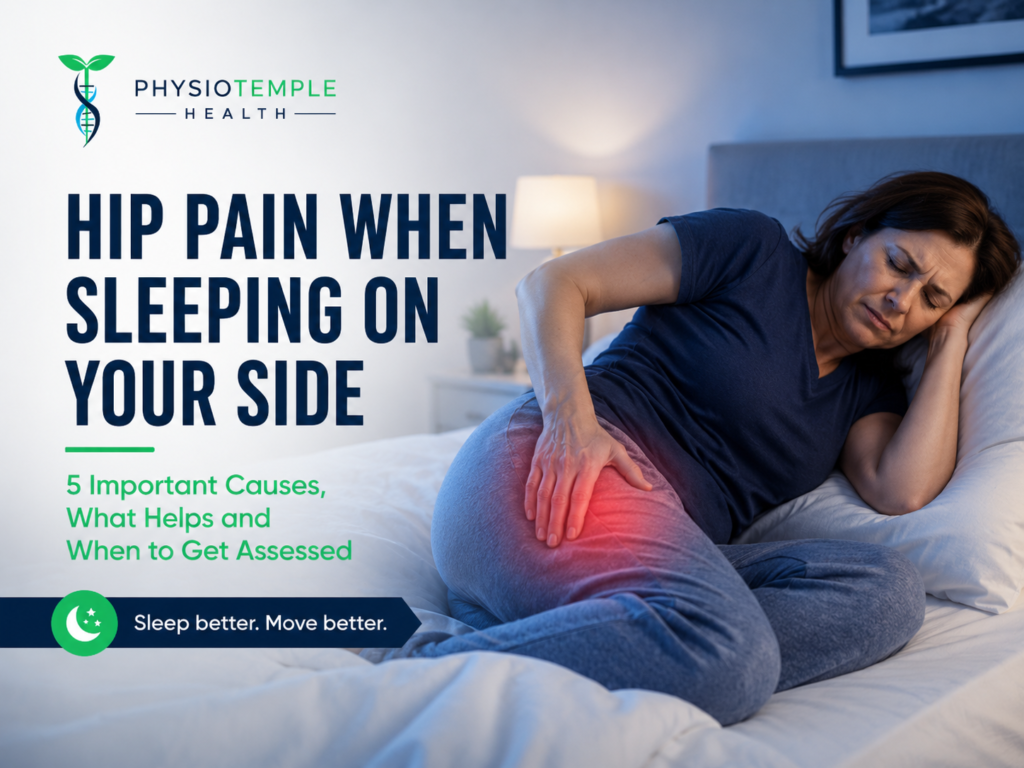
Hip pain when sleeping on your side often happens because direct pressure is placed on sensitive muscles, tendons, bursae, or joints around the hip. Greater trochanteric pain syndrome, hip arthritis, changes in activity, sleeping position, and pain referred from the lower back are possible contributors.
The exact location of the pain matters. Outer hip pain is more commonly linked to nearby soft tissues, while pain felt deeper in the groin may suggest the hip joint itself. Hip pain can also sometimes come from the lower back.
What Hip Pain When Sleeping on Your Side Can Feel Like
Hip pain when sleeping on your side may feel like:
- Aching or burning on the outside of the hip
- Tenderness over the bony area at the side of the hip
- Pain that travels down the outside of the thigh
- Deep pain inside the groin
- Stiffness after waking up
- Pain when rolling over in bed
- Discomfort while climbing stairs
- Pain when standing on one leg
- Symptoms after prolonged walking or standing
- Difficulty staying on one side during the night
Pain on the outside of the hip that becomes worse when lying directly on it is commonly associated with greater trochanteric pain syndrome, also called lateral hip pain.
5 Important Causes of Hip Pain When Sleeping on Your Side
1. Greater trochanteric pain syndrome
Greater trochanteric pain syndrome, or GTPS, affects the soft tissues around the outside of the hip. This may involve the gluteal tendons, surrounding muscles, or bursae near the greater trochanter.
Common symptoms include:
- Outer hip pain
- Tenderness when touching the side of the hip
- Pain when lying on the affected side
- Pain while climbing stairs
- Discomfort after walking or standing
- Pain when standing mainly on one leg
- Symptoms that travel down the outside of the thigh
GTPS was previously often called trochanteric bursitis, but the tendons and other surrounding tissues may also be involved. Direct pressure from side sleeping can irritate an already sensitive area.
2. Hip osteoarthritis
Hip osteoarthritis affects the cartilage and other structures inside the hip joint. Symptoms may gradually become more frequent and can eventually occur during rest or at night.
You may notice:
- Deep pain in the groin
- Pain around the front or side of the hip
- Morning stiffness
- Reduced hip movement
- Difficulty putting on shoes or socks
- Pain while walking or using stairs
- Aching after sitting for a long time
- Night pain that interrupts sleep
Hip arthritis does not always cause obvious outer hip tenderness. Pain from the joint is commonly felt in the groin but can also spread toward the thigh, buttock, or knee.
3. Direct pressure and sleeping position
Sleeping directly on a painful hip places pressure over the side of the joint and nearby soft tissues. Even the opposite side can sometimes become uncomfortable if the upper leg drops forward and places the hip in an irritated position.
Your sleeping setup may be contributing if:
- Pain develops soon after lying on one side
- Rolling onto your back reduces the discomfort
- A pillow between your legs helps
- Your upper knee falls far forward
- Your mattress allows your hip to sink deeply
- You repeatedly wake after rolling onto the painful side
Sleeping position may aggravate hip pain, but it is not always the original cause. If the area is already sensitive, lying on it for several hours can make the symptoms more noticeable.
4. A sudden change in activity or hip strength
The tissues around the hip need time to adapt to changes in workload. Symptoms may appear after suddenly increasing walking, running, stairs, workouts, physical work, or standing.
Possible triggers include:
- Starting a new exercise routine
- Increasing running distance
- Walking more while travelling
- Returning to sports after time off
- Repeated stair climbing
- Standing for longer shifts
- Sudden hill training
- Lower activity followed by a rapid return
Both sudden increases and significant decreases in activity may affect how well the hip tolerates load. Outer hip symptoms are often associated with changes in activity and irritation of the gluteal tendons.
A physiotherapy assessment in Vaughan can help identify strength, movement, walking, and activity factors that may be contributing.
5. Pain referred from the lower back
Pain felt near the hip does not always begin in the hip itself. Lower-back problems can sometimes refer pain into the buttock, outer hip, thigh, or leg.
This may be more likely when you also have:
- Lower-back pain or stiffness
- Pain travelling below the hip
- Tingling or numbness
- Symptoms that change with spinal movement
- Pain after prolonged sitting
- Discomfort in the buttock and leg
- Pain that does not feel tender directly over the hip
An assessment may need to examine the lower back, hip, and surrounding areas to better understand where the symptoms are coming from.
Depending on the findings, chiropractic care in Vaughan may be considered when lower-back or joint mobility factors are involved.
5 Ways to Sleep More Comfortably With Hip Pain
1. Avoid lying directly on the painful side
Try sleeping on your back or on the less painful side.
If you regularly roll onto the painful hip, placing a pillow behind your back may help keep you from turning during the night.
2. Place a pillow between your legs
When sleeping on your side, place a pillow between your knees and lower legs. This may help keep the upper hip and leg more supported instead of allowing them to drop forward.
A pillow that supports only the knees may not be enough for everyone. Supporting the knees and shins can help keep the legs more level. NHS physiotherapy guidance commonly recommends using a pillow between the legs when lying on the non-painful side.
3. Support the painful leg when sleeping on your back
When lying on your back, try placing a pillow underneath your knees. This may make the hips and lower back feel more relaxed.
Use a position that feels supported rather than forcing your legs into a specific angle.
4. Reduce aggravating activities temporarily
During a flare-up, consider temporarily reducing activities that clearly increase the pain, such as:
- Long walks
- Hill training
- Running
- Repeated stairs
- Standing mainly on one leg
- Sitting with your legs crossed
- Leaning heavily onto one hip
This does not mean complete rest. Continue comfortable daily movement and gradually rebuild activity as your symptoms allow.
5. Begin gradual hip strengthening
The muscles around the hip help control the pelvis and absorb load during walking, stairs, exercise, and daily movement.
A rehabilitation program may include:
- Hip abductor strengthening
- Gluteal strengthening
- Controlled sit-to-stand exercises
- Balance work
- Gradual walking progressions
- Lower-body movement training
Do not force an exercise that causes sharp pain or significantly worsens your night symptoms. The right starting point depends on your pain level, strength, activity, and suspected cause.
Do This, Avoid This
Do This
- Sleep on your back or less painful side
- Place a pillow between your knees and lower legs
- Keep moving within a comfortable range
- Reduce activities that clearly cause a flare-up
- Build hip strength gradually
- Pay attention to where the pain is located
- Get assessed when pain repeatedly affects sleep
Avoid This
- Lying directly on the painful hip for hours
- Crossing your legs if it increases symptoms
- Hanging your weight onto one hip while standing
- Aggressively stretching into sharp pain
- Suddenly increasing running or walking volume
- Assuming every outer hip pain is bursitis
- Completely avoiding all movement
Can Massage Help Hip Pain at Night?
Massage may help when tight or overworked muscles around the hip, glutes, thighs, or lower back are contributing to your discomfort.
It may be used to reduce muscle tension and make movement more comfortable, but it does not treat every possible cause of hip pain. Hip arthritis, significant injuries, referred nerve pain, and persistent tendon problems may require a broader treatment plan.
Read more about massage therapy for tight muscles and stress or visit our massage therapy page to learn how massage may fit into your care.
When to Book a Hip Assessment
Consider booking an assessment if:
- Hip pain when sleeping on your side repeatedly wakes you
- Pain is getting worse or keeps returning
- You have difficulty walking or using stairs
- The hip feels weak, stiff, or unstable
- You have pain during exercise or daily activities
- Symptoms continue despite changing your sleeping position
- Pain spreads into the groin, thigh, or lower leg
- You also have lower-back pain, numbness, or tingling
- Your hip pain affects work, sleep, or normal activities
Hip pain that interferes with sleep, keeps returning, or affects normal activities should be assessed rather than repeatedly ignored.
At Physiotemple Health, your assessment may include:
- Hip range of motion
- Strength testing
- Walking and balance
- Lower-back screening
- Review of your exercise or work demands
- Sleep-position guidance
- A personalized rehabilitation plan
Depending on your findings, care may include physiotherapy, chiropractic care, massage therapy, acupuncture, exercise, or a combination.
When Hip Pain Needs Urgent Medical Attention
Seek urgent medical care if:
- Your pain started after a serious fall or accident
- You cannot stand or put weight on the leg
- The hip looks deformed or out of place
- Your leg appears shorter than normal
- You have intense pain or sudden swelling
- The hip is red, hot, or swollen
- You have fever, chills, or feel seriously unwell
- You suddenly cannot move the hip or leg
These symptoms may be associated with a fracture, dislocation, infection, or another condition that requires prompt medical assessment.
FAQs About Hip Pain When Sleeping on Your Side
Why does my hip hurt only when I sleep on it?
Direct pressure may irritate sensitive tissues around the outside of the hip. GTPS, gluteal tendon irritation, bursitis, arthritis, or a previous injury may make the area less tolerant of prolonged side lying.
Is outer hip pain always bursitis?
No. Outer hip pain may involve the gluteal tendons, muscles, bursae, or pain referred from another area. GTPS is a broader term that includes several possible soft-tissue contributors.
Which side should I sleep on with hip pain?
Try sleeping on your back or the less painful side. When side sleeping, place a pillow between your knees and lower legs to support the upper hip.
Can physiotherapy help hip pain when sleeping?
Physiotherapy may help assess hip strength, mobility, walking, activity tolerance, and possible lower-back involvement. Treatment may include education, activity changes, strengthening, and gradual return to normal activity.
Can chiropractic care help hip pain?
Chiropractic care may be considered when restricted movement or lower-back and pelvic factors are contributing. The treatment plan should depend on the assessment rather than assuming all hip pain has the same cause.
Should I stretch the painful hip?
Gentle movement may feel helpful, but aggressive stretching can aggravate certain types of outer hip pain. Exercises and stretches should be chosen based on your symptoms and assessment.
Book Help for Hip Pain in Woodbridge
If hip pain when sleeping on your side is affecting your sleep, walking, exercise, or daily activities, Physiotemple Health can assess your hip movement, strength, lower back, activity demands, and sleeping habits.
📍 12 Woodstream Blvd, Unit 5, Woodbridge, ON
📞 Call or text: 905-995-4456
📅 Book Online: https://physiotemple.juvonno.com/portal/publicbook.php?step=practitioner&branch_id=1
Book an assessment today and get a clearer plan for your hip pain and sleep.